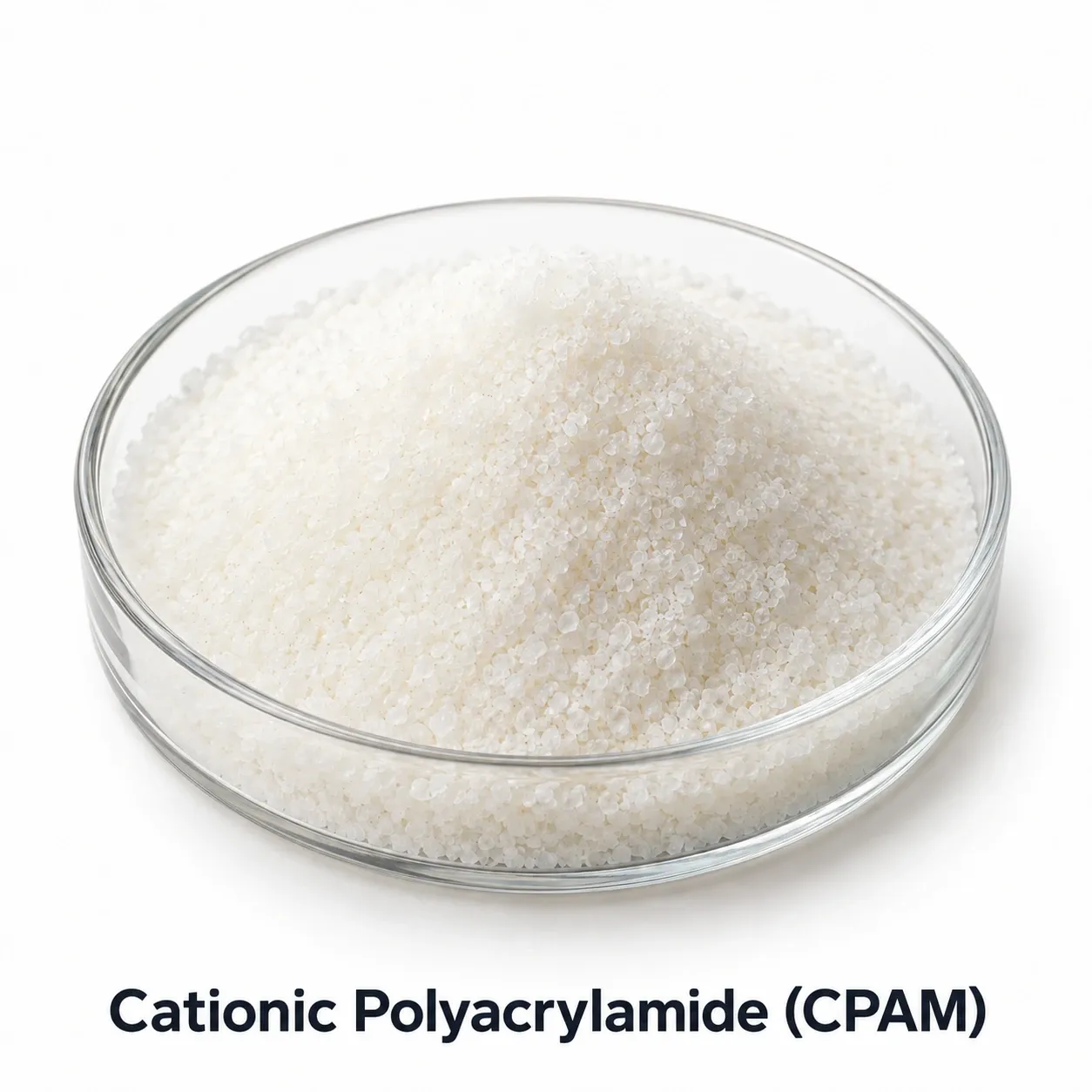
This product is copolymerized from cationic monomers (DM, DMC, CPF, DMDAAC, DMAEMA, etc.) and acrylamide, and manufactured through granulation, drying and pulverization into white small‑size granules or powder. Cationic Polyacrylamide (CPAM) is a linear high‑molecular‑weight compound. With multiple active groups, it can form hydrogen bonds via affinity and adsorption with many substances. It mainly flocculates negatively‑charged colloids, and delivers functions of oil removal, decolorization, adsorption and adhesion. It is applicable for high‑content wastewater treatment in dyeing, papermaking, food, construction, metallurgy, mineral processing, coal‑washing, oilfield, aquatic‑product processing and fermentation industries. It is especially suitable for dewatering treatment of municipal sewage, municipal sludge, papermaking sludge and other types of industrial sludge.
This product is copolymerized from cationic monomers (DM, DMC, CPF, DMDAAC, DMAEMA, etc.) and acrylamide, and manufactured through granulation, drying and pulverization into white small‑size granules or powder. Cationic Polyacrylamide (CPAM) is a linear high‑molecular‑weight compound. With multiple active groups, it can form hydrogen bonds via affinity and adsorption with many substances. It mainly flocculates negatively‑charged colloids, and delivers functions of oil removal, decolorization, adsorption and adhesion. It is applicable for high‑content wastewater treatment in dyeing, papermaking, food, construction, metallurgy, mineral processing, coal‑washing, oilfield, aquatic‑product processing and fermentation industries. It is especially suitable for dewatering treatment of municipal sewage, municipal sludge, papermaking sludge and other types of industrial sludge.
| Item | Index |
|---|---|
| Appearance | White or slight‑yellow granules |
| Molecular Weight, ten thousand | ≥800 |
| Solid Content, % | ≥89 |
| Cationic Degree, % | 5‑80 |
| Dissolving Time, min | ≤90 |
| Water‑Insoluble Matter, % | ≤0.2 |
| Acrylamide Monomer, % | ≤0.15 |
Packed in kraft paper bags with inner plastic liner, 25 kg per bag. This product is hygroscopic. Keep hermetically sealed in cool and dry place. Do not spill solid product on the ground to prevent slippery floor caused by water absorption.