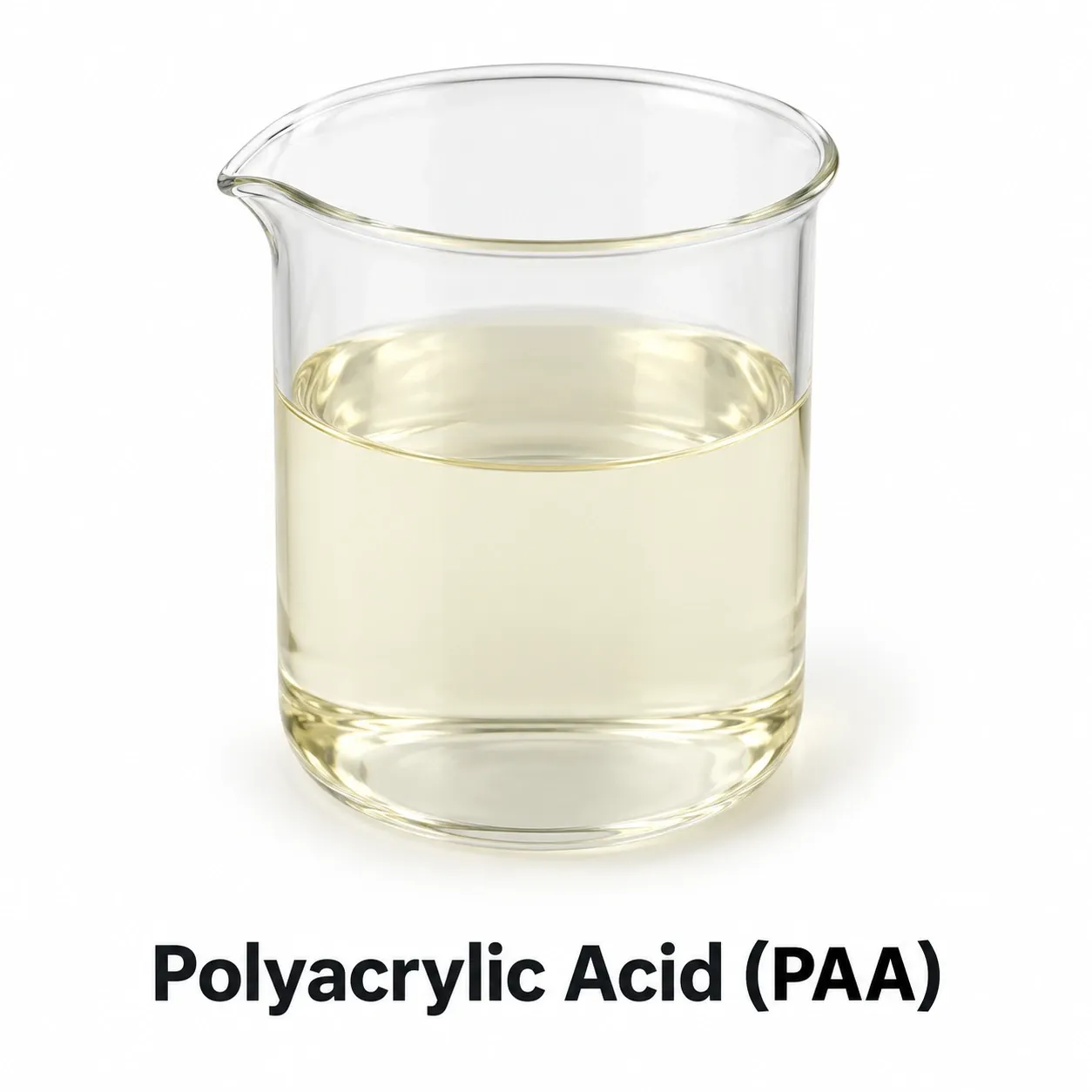
PAA is non‑toxic and readily soluble in water. It can operate under alkaline and moderate concentration‑multiplier conditions without scaling. It disperses micro‑crystals and sediment of calcium carbonate, calcium sulfate and other salts in water to prevent precipitation, so as to achieve scale inhibition.
PAA is non‑toxic and readily soluble in water. It can operate under alkaline and moderate concentration‑multiplier conditions without scaling. It disperses micro‑crystals and sediment of calcium carbonate, calcium sulfate and other salts in water to prevent precipitation, so as to achieve scale inhibition.
| Item | Custom Grade | GB/T10533‑2014 |
|---|---|---|
| Appearance | Colorless to light‑yellow transparent liquid | Colorless to light‑yellow transparent liquid |
| Solid Content % | ≥30.0 | ≥40.0 |
| Free Monomer % | ≤0.50 | ≤0.5 |
| Density (20℃), g/cm³ | ≥1.09 | ≥1.12 |
| pH (1% aqueous solution) | ≤3.0 | 2.5‑4.5 |
| Intrinsic Viscosity (30℃), dl/g | 0.06‑0.10 | 0.06‑0.12 |
Note: Polyacrylic acid with different molecular weights and solid contents (e.g. 50 %, 60 %) can be customized per customer requirements.
PAA is usually formulated together with other water treatment agents. The specific formula and dosage shall be determined by on‑site tests according to water quality and equipment conditions. When used alone, the typical dosage is 1‑15 mg/L. For other applications such as concrete water‑reducing agent and textile printing‑dyeing, dosage shall be confirmed by tests.
Packed in 25 KG plastic drums. Store indoors in cool place. Shelf life: 12 months.
This product is weakly acidic. Take labor‑protection measures during operation. Avoid contact with skin and eyes. Rinse with plenty of clean water upon contact.