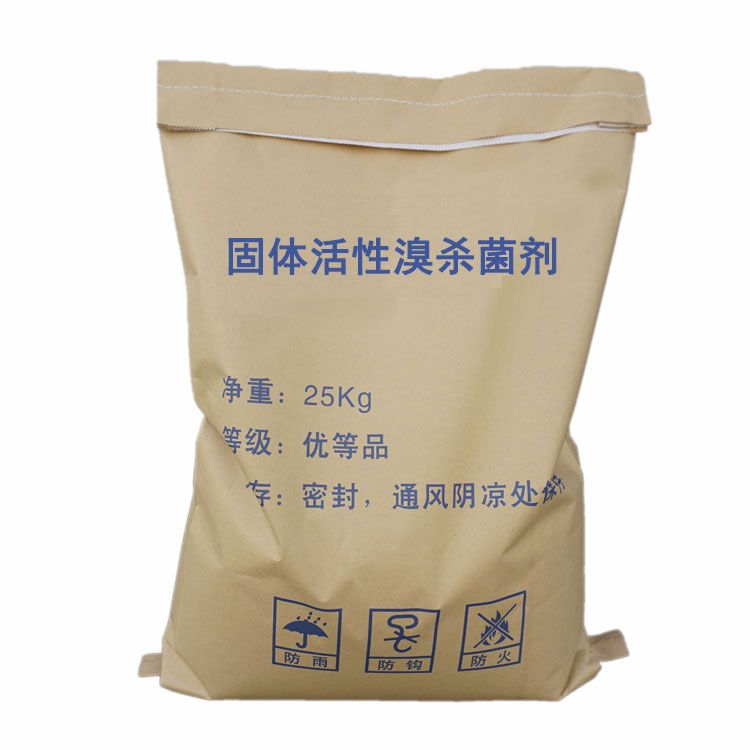
This product is mainly composed of bromine‑containing and chlorine‑containing active substances and auxiliary agents. In circulating water, bromide ions are oxidized by hypochlorous acid to generate hypobromous acid (HBrO) and hypobromite ion (BrO⁻), converting the chlorine‑based biocidal system into highly reactive bromine species.
This product is mainly composed of bromine‑containing and chlorine‑containing active substances and auxiliary agents. In circulating water, bromide ions are oxidized by hypochlorous acid to generate hypobromous acid (HBrO) and hypobromite ion (BrO⁻), converting the chlorine‑based biocidal system into highly reactive bromine species.
New‑ecology oxygen generated from the decomposition of HClO and HBrO delivers oxidative disinfection. Meanwhile, released free activated chlorine and activated bromine react with nitrogen‑containing substances to form chloramines and bromamines, which interfere with the metabolic processes of microbial cells.
Its biocidal activity is far superior to chlorine under alkaline water‑treatment conditions. In cooling water with high‑pH / alkaline conditions, hypochlorous acid produced by chlorine hydrolysis dissociates into hypochlorite ions with poor biocidal performance, greatly weakening disinfection efficiency. By contrast, hypobromous acid from bromine hydrolysis has a much lower dissociation tendency. At pH 8.2, hypochlorous acid retains only 20 % activity, while hypobromous acid still maintains 85 % biocidal efficiency. Therefore, active‑bromine biocide is especially suitable for alkaline water systems, and works within pH 6.5‑9.5.
It serves as biocide for circulating cooling‑water and wastewater treatment. It can replace liquid chlorine, and may also be used alternately with non‑oxidizing biocides. At high dosage, it acts as biocide and slime remover for circulating cooling‑water systems.
| Item | Specification |
|---|---|
| Appearance | White solid |
| Active Content | ≥38 % |
Dose at 10‑30 mg/L based on system hold‑up volume. For general systems, maintain residual bromine (chlorine) at 0.3‑1.0 mg/L for 2‑4 hours, 2‑3 times per week to eliminate bacteria and algae. Actual dosage may be lower, subject to water quality and seasonal conditions. In summer, when other biocides fail or heavy slime accumulates in circulating cooling‑water, keep residual bromine (chlorine) at 0.5‑1.5 mg/L.
Packed in 20 kg calcium‑plastic box or 25 kg plastic drum with inner plastic bag. Store indoors in ventilated and dry conditions. Shelf‑life: 10 months.
Active‑bromine biocide is oxidizing. Wear protective gloves and goggles during handling. Avoid skin and eye contact. In case of contact, flush with large quantities of clean water.