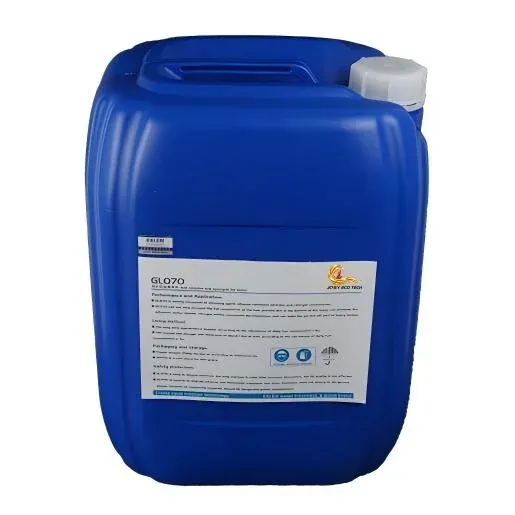
The boiler ash‑prevention & efficiency‑enhancing agent is a new energy‑saving and environment‑friendly chemical developed based on boiler scaling characteristics and ash‑cleaning enhancement mechanism during boiler combustion. It is mainly composed of oxidants, alkaline corrosion inhibitors and catalysts. It can boost full fuel combustion and prevent slag adhesion at boiler bottom. It also accelerates transformation and decomposition of sulfur dioxide and nitrogen‑oxygen compounds, peels off old ash deposits and immobilizes partial heavy metals.
The boiler ash‑prevention & efficiency‑enhancing agent is a new energy‑saving and environment‑friendly chemical developed based on boiler scaling characteristics and ash‑cleaning enhancement mechanism during boiler combustion. It is mainly composed of oxidants, alkaline corrosion inhibitors and catalysts. It can boost full fuel combustion and prevent slag adhesion at boiler bottom. It also accelerates transformation and decomposition of sulfur dioxide and nitrogen‑oxygen compounds, peels off old ash deposits and immobilizes partial heavy metals.
Its functions are realized via the following mechanisms:
| Item | Index |
|---|---|
| Appearance | White powder |
| pH | Weakly alkaline |
‑ Long‑term maintenance dosage: 10 parts per ten‑thousand of daily fuel consumption. ‑ Normal ash‑removal dosage: When ash thickness is below approx. 1 mm, dosage equals 20 parts per ten‑thousand of daily fuel consumption. ‑ Initial dosing: When ash thickness exceeds 1 mm, adopt 1‑2 times normal ash‑removal dosage and extend ash‑cleaning cycle accordingly.
For both positive‑pressure and negative‑pressure boilers, use special tools or dosing tanks. Spray into furnace through observation hole by compressed air (working pressure: 2.5‑4 kg/cm²). Spray atomized agent evenly into high‑temperature zones of furnace from multiple points. (Applicable temperature ≥500 ℃).
Supplied by original manufacturer for stable physicochemical performance. Standard package: 25 kg blue plastic‑woven bags; customized specifications available. Store in cool place. Shelf life: 12 months.
GL‑070 boiler ash‑prevention & efficiency‑enhancing agent is neutral to weakly alkaline, non‑flammable, non‑explosive, non‑toxic and odorless. It is not classified as hazardous goods, yet it contains oxidants and shall be managed as hazardous material. It is hygroscopic. Store in cool, ventilated and dry warehouse. Hygroscopic condition only causes color change without impairing product quality.